
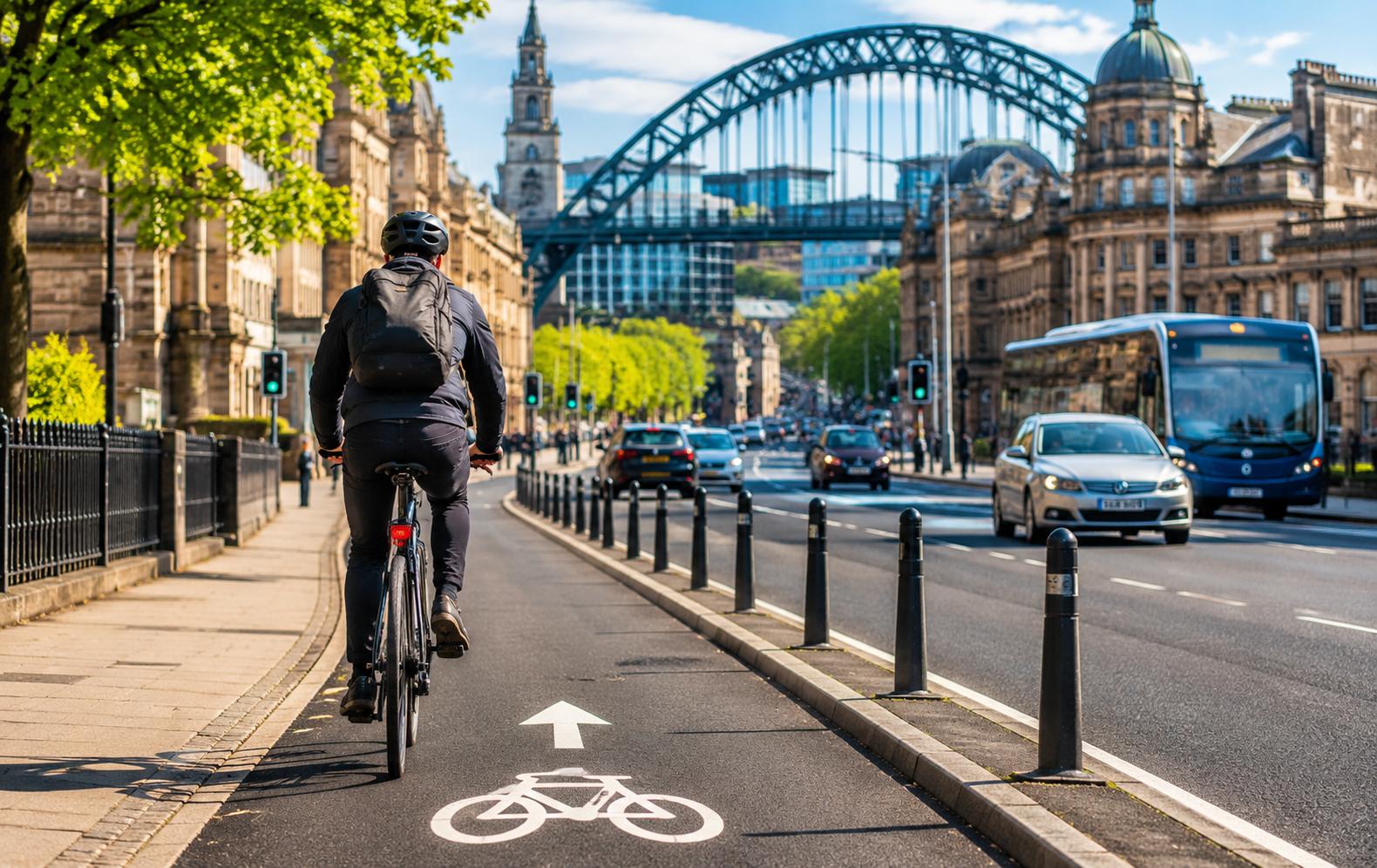
Newcastle City Council has unveiled fresh plans for a new cycle lane that would connect Newcastle city centre with the Royal Victoria Infirmary and the Town Moor, marking another major step in the city’s long-running push towards improved active travel infrastructure.
The proposed route along Leazes Park Road is designed to strengthen links between key destinations in Newcastle upon Tyne, including the RVI, Newcastle University, St James’ Park and the city centre. Council leaders believe the project could encourage more residents to choose cycling for daily journeys while also helping reduce congestion and pollution in some of the city’s busiest areas.
The announcement comes at a politically significant moment for the council following dramatic local election results that left no single party in overall control of Newcastle City Council. Despite the political uncertainty, transport improvement projects across the city appear set to continue.
New Cycle Route Planned For Newcastle City Centre Connections.
Under the latest proposals, a new contraflow cycle lane would be introduced along Leazes Park Road to connect with the existing cycling infrastructure on Queen Victoria Road outside the RVI.
Council officials say the route would provide a more direct and safer option for cyclists travelling between Newcastle city centre and major locations in the north-west of the city. The plans are expected to form part of a wider long-term cycling network that could eventually extend further if additional funding becomes available.
A spokesperson for Newcastle City Council said the scheme recognises the growing demand for better cycling connections across Newcastle upon Tyne.
They explained that improving links between the Town Moor, Newcastle University, the RVI hospital and the city centre would help create a more joined-up transport network while encouraging healthier travel habits.
The council also confirmed that work could begin during the summer months as part of wider improvements scheduled for the busy Gallowgate and Percy Street junction.
Traffic Signal Upgrades And Pedestrian Improvements Planned.
As part of the wider transport improvement programme, Newcastle City Council also plans to upgrade traffic signals and pedestrian crossings near Gallowgate and Percy Street.
Transport planners believe combining these projects will minimise disruption while delivering broader improvements for pedestrians, cyclists and motorists using the area every day.
Leazes Park Road plays an important role in connecting several major Newcastle landmarks. Thousands of commuters, students, hospital workers and football supporters travel through the area each week, especially on matchdays at nearby St James’ Park.
Supporters of the project argue that safer cycling routes could ease pressure on surrounding roads while making travel around Newcastle city centre more accessible for residents without cars.
How Covid Changed Cycling In Newcastle Upon Tyne.
Many of Newcastle’s recent cycling projects can be traced back to changes first introduced during the Covid-19 pandemic.
The existing Queen Victoria Road cycle lane outside the RVI was originally installed as a temporary emergency measure designed to allow safer social distancing for cyclists and pedestrians. However, after further reviews and public consultation, the council later decided to make the route permanent.
The upgraded two-way cycle track officially opened in 2024 as part of a £2.95 million investment package that also delivered enhanced pedestrian crossings and redesigned road layouts near the hospital.
Council documents suggest officials now see the Queen Victoria Road route as a key foundation for future active travel expansion across Newcastle upon Tyne.
Transport leaders have repeatedly stated that creating connected cycling infrastructure is essential if more people are to feel confident about travelling by bike for everyday journeys.
Newcastle’s Active Travel Ambitions Continue To Grow.
The latest Leazes Park Road proposal forms part of a much larger strategy aimed at reshaping transport across Newcastle.
Local authorities across the UK have faced increasing pressure to improve active travel infrastructure as councils attempt to reduce carbon emissions, tackle congestion and improve public health.
In Newcastle upon Tyne, investment in cycling and walking infrastructure has become a major focus over recent years, although not all projects have received universal support.
Council reports linked to the latest scheme state there are still “long term aspirations” to continue expanding cycling connections through Newcastle city centre and surrounding neighbourhoods.
Supporters say the improvements could help transform how residents move around the city in the coming years, especially as fuel costs and traffic pressures continue to rise.
Political Uncertainty Surrounds Newcastle City Council.
The timing of the latest announcement has attracted additional attention following major political changes at Newcastle City Council.
The official decision notice for the Leazes Park Road plans was published on May 6, just one day before local elections dramatically reshaped the council chamber.
Labour lost overall control of Newcastle City Council, leaving no party with a governing majority. The Liberal Democrats secured 25 seats, while both Reform UK and the Green Party won 24 seats each.
However, the Greens currently hold one fewer active councillor after Arthur’s Hill representative Mohammed Suleman was suspended from the party.
The political uncertainty has raised questions about how major transport projects and infrastructure spending priorities could develop over the next 12 months.
Despite this, council officers appear determined to continue progressing active travel schemes already in development.
Gosforth High Street Cycle Lane Dispute Intensifies.
While Newcastle City Council moves forward with new cycling plans near the city centre, controversy continues to grow over proposals affecting Gosforth High Street.
Campaigners have reacted angrily to suggestions that dedicated cycle lanes along the busy route could be removed in favour of expanded bus lanes.
The original protected cycling routes were first introduced in 2020 during the pandemic when temporary bollards created additional space for cyclists and pedestrians. Those bollards were later removed in 2023 and replaced with a bus lane arrangement.
Now, further redesign proposals have sparked fresh criticism from cycling groups and local residents who fear road safety could worsen.
Current plans would remove the protected northbound cycle lane between Salters Road and Regent Farm Road, along with a painted southbound cycle lane between Church Road and Ivy Road.
At the same time, the council wants to introduce three new sections of northbound bus lane along the Great North Road.
Residents Fear Cycling Changes Could Reduce Safety.
Opponents of the Gosforth proposals argue that removing protected cycling space could make travelling by bike significantly more dangerous, particularly for children and families.
Local resident Sally Watson, who was involved in a collision with her daughter near the Moor Road South and Moorfield junction in 2019, criticised the latest plans.
She said the council appeared to be making it harder for people to walk and cycle safely while failing to improve surrounding streets.
Another resident, Siobhan Still, warned that removing cycle lanes could discourage children from travelling independently and safely through Gosforth.
Campaigners also expressed disappointment that several previously discussed safety measures no longer appear in the latest designs.
These include a proposed two-way cycle lane north of Christon Road, a dedicated crossing on Christon Road and a safer route connecting West Avenue with Gosforth Central Park.
Debate Over Public Transport And Active Travel Priorities.
The dispute over Gosforth High Street reflects a wider national debate about how cities should balance public transport improvements with cycling infrastructure.
Supporters of the bus lane expansion argue that improving bus reliability could encourage more people to leave their cars at home, reducing congestion across Newcastle upon Tyne.
Critics, however, claim the proposals prioritise through traffic over local residents and active travel users.
Conservative councillor Doc Anand criticised what he described as “top-down experiments” and called for stronger public consultation before major transport changes are approved.
Newcastle City Council has defended its approach, stating that extensive consultations were carried out in 2025 regarding both active travel and public transport proposals.
Officials also confirmed that additional plans for cycling links running parallel to Gosforth High Street may still be introduced in future phases of development.
Future Of Cycling In Newcastle Upon Tyne Remains Under Spotlight.
The latest developments highlight how cycling infrastructure remains one of the most divisive transport issues in Newcastle upon Tyne.
For some residents, safer cycling routes represent a necessary investment in the city’s future, helping create cleaner air, healthier communities and more sustainable transport choices.
Others remain concerned about road layouts, congestion and the impact changes may have on local businesses and traffic flow.
What is clear is that Newcastle’s transport network is continuing to evolve rapidly. With further projects expected over the coming years, debates around cycling, buses and pedestrian access are unlikely to disappear any time soon.
As consultation periods continue and political leadership at Newcastle City Council remains uncertain, residents across Newcastle upon Tyne will be watching closely to see how these ambitious transport plans develop.
What do you think about Newcastle’s latest cycle lane plans and the future of active travel in Newcastle upon Tyne? Share your views in the comments and join the conversation with local readers today.
Have your say on the changes affecting Newcastle city centre, Gosforth and the wider North East transport network - your opinion matters.
Local News
Newcastle Cycle Lane Expansion Plans Spark Debate Over City Travel Future.
Advertisement




Comments (0)
You must be logged in to post comments.
Don't have an account? Register here
No comments yet. Be the first to share your thoughts!