
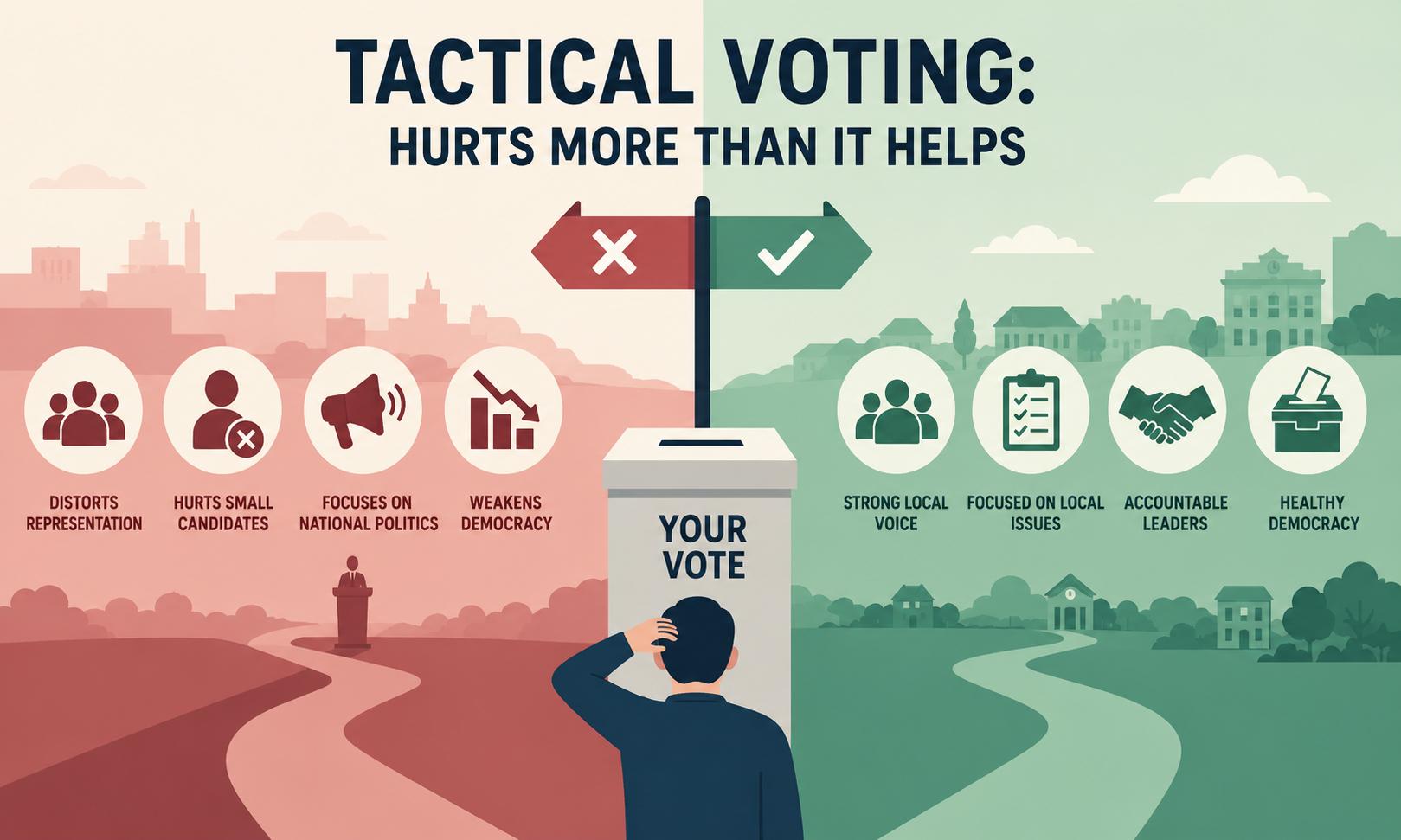
Tactical voting has become an increasingly common feature of modern British politics, particularly during tightly contested elections. Often promoted as a strategic way to prevent a disliked party from winning, tactical voting encourages people to vote for a candidate they believe has the best chance of defeating another, rather than supporting the party or individual they genuinely prefer.
While supporters argue that tactical voting is a practical response to the UK’s first-past-the-post electoral system, critics say it can undermine democracy, weaken local representation and discourage meaningful political engagement - especially in local elections.
As local elections continue to shape decisions on housing, transport, public services and council spending, the debate around tactical voting is becoming more significant than ever.
What Is Tactical Voting?
Tactical voting occurs when voters choose a candidate based not on preference, but on perceived electability. For example, a voter may support one party politically but decide to back another candidate they believe is better positioned to defeat a rival.
In parliamentary elections, tactical voting campaigns have grown in popularity through online tools, social media and coordinated anti-party campaigns. However, in local elections, where communities are smaller and individual councillors often have a more direct relationship with residents, the consequences of tactical voting can be more complex.
Critics argue that local elections should focus on local issues, candidate quality and community priorities rather than national political strategies.
Tactical Voting Can Distort Genuine Public Opinion.
One of the biggest criticisms of tactical voting is that it can create election results that do not accurately reflect what voters truly believe.
When large numbers of people vote tactically, the final result may appear to show strong support for a candidate or party that many residents do not actually support ideologically. This can make it harder for political parties and councillors to understand what voters genuinely want.
In local government, where councils make decisions that directly affect day-to-day life, distorted voting patterns can weaken accountability. Councillors may struggle to interpret whether they were elected because residents supported their policies or simply because they were seen as the “least bad” option.
Over time, this can reduce trust in local democracy and create confusion about public priorities.
Smaller Parties and Independent Candidates Often Suffer.
Tactical voting can also make it more difficult for smaller parties and independent candidates to compete effectively.
Local elections have traditionally offered opportunities for independents and community-focused candidates to gain support based on neighbourhood issues rather than national party politics. However, tactical voting often pushes voters toward larger parties perceived to have a stronger chance of winning.
This can discourage political diversity and reduce the range of voices represented in local councils.
Independent candidates frequently campaign on hyper-local concerns such as road safety, planning decisions, anti-social behaviour or protecting community facilities. Yet tactical voting campaigns may persuade residents to abandon those candidates in favour of larger party contenders viewed as strategically important.
Critics argue this weakens grassroots democracy and limits genuine local representation.
Local Elections Risk Becoming National Political Battles.
Another concern is that tactical voting shifts attention away from local issues and turns council elections into national political contests.
Rather than evaluating councillors based on their track record, community engagement or local plans, voters may focus primarily on sending a message to Westminster or influencing broader party politics.
This trend can harm local governance by reducing scrutiny of actual council performance.
Issues such as waste collection, road maintenance, social care, regeneration projects and local business support can become overshadowed by national political narratives. As a result, candidates with strong local credentials may lose out to those benefiting from wider tactical campaigns.
Many political analysts argue that local elections work best when residents vote based on who they believe will deliver effectively for their community, rather than as part of a broader national strategy.
Tactical Voting May Reduce Long-Term Political Engagement.
Some critics believe tactical voting can also discourage long-term engagement with politics.
When voters repeatedly feel pressured to back a “lesser evil” instead of their preferred candidate, frustration and disillusionment can grow. People may begin to feel their genuine political views are irrelevant or that voting is simply about blocking outcomes rather than supporting positive ideas.
This can contribute to declining trust in democratic institutions and lower voter enthusiasm over time.
Younger voters in particular may become disengaged if they believe the electoral system forces them into strategic choices rather than authentic participation.
In local elections, where turnout is often already lower than in general elections, maintaining meaningful voter engagement remains a major challenge.
Why Some Still Defend Tactical Voting.
Despite criticism, supporters of tactical voting argue it remains a rational response to the UK’s electoral system.
Under first-past-the-post, candidates can win without securing a majority of votes, leading some voters to feel their preferred choice has little chance of success. Tactical voting, supporters say, allows residents to maximise the impact of their vote and prevent outcomes they strongly oppose.
Advocates also argue that tactical voting can encourage cooperation between parties and help challenge dominant political control in certain areas.
The debate therefore often centres not only on tactical voting itself, but on whether the electoral system encourages strategic behaviour in the first place.
Calls for Electoral Reform Continue.
The rise of tactical voting has fuelled wider discussions around electoral reform in the UK.
Supporters of proportional representation argue that alternative voting systems could reduce the need for tactical voting by ensuring seats more accurately reflect voter preferences. Others maintain that first-past-the-post provides stability and clear outcomes despite its limitations.
Regardless of the system, the conversation around tactical voting highlights growing public frustration with how elections function and how votes translate into political power.
The Future of Local Democracy.
As local elections continue to influence key decisions affecting communities across the UK, the debate around tactical voting is unlikely to disappear.
For some voters, tactical voting remains a necessary political strategy. For others, it risks weakening democracy by encouraging fear-based decision-making instead of genuine support for candidates and policies.
Ultimately, the discussion raises broader questions about representation, trust and the purpose of local elections themselves - whether they should primarily reflect strategic political calculations or the authentic priorities of local communities.
Local News
Why Tactical Voting Can Hurt Local Democracy More Than It Helps
Advertisement



Comments (0)
You must be logged in to post comments.
Don't have an account? Register here
No comments yet. Be the first to share your thoughts!